
Why Canon RF Lenses?
What Makes Canon's RF Mount Different
If you own a Canon EOS R-series camera, or you're thinking about buying one, the lens question is just as important as the
body question. Canon's RF mount was designed from scratch for full-frame mirrorless cameras, and the lenses built for it
benefit from that fresh-sheet design in ways EF lenses (Canon's older DSLR mount) couldn't.
Here's what makes RF lenses worth investing in if you're building out a Canon mirrorless kit.
A Mount Built for Mirrorless from the Start
Mirrorless cameras don't need a flip-up mirror inside the body, which means lens designers can place the rear element of the
lens closer to the sensor. Canon's RF mount takes advantage of that shorter flange distance, paired with a wide mount diameter,
to give lens designers more room to work with. The result is optical designs that were difficult or expensive to achieve on the
older EF mount.
Native Compatibility with EOS R Cameras
Every current Canon EOS R-series camera, from the entry-level R50 to the flagship R1, uses the same RF mount. That means RF lenses
work natively without an adapter, with full electronic communication for autofocus, image stabilization coordination, and lens
correction profiles. RF-S lenses are designed specifically for APS-C R-series bodies (like the R50 and R7), while RF lenses cover
the full-frame R-series bodies (like the R6 Mark III and the R5 Mark II).
Image Stabilization Coordination
Many modern Canon RF lenses include their own optical Image Stabilization (IS). When paired with a body that has In-Body Image
Stabilization (like the R6 Mark III, with up to 8.5 stops of IBIS), the lens and body can coordinate their stabilization for
steadier handheld work, especially in low light or at longer focal lengths.
Multi-Function Control Ring
Many RF lenses include a Control Ring (in addition to focus and zoom rings) that can be assigned to functions like aperture, ISO,
or exposure compensation. It's the kind of small ergonomic detail that pays off the more you use the system.
A Lineup That Spans Beginner to Pro
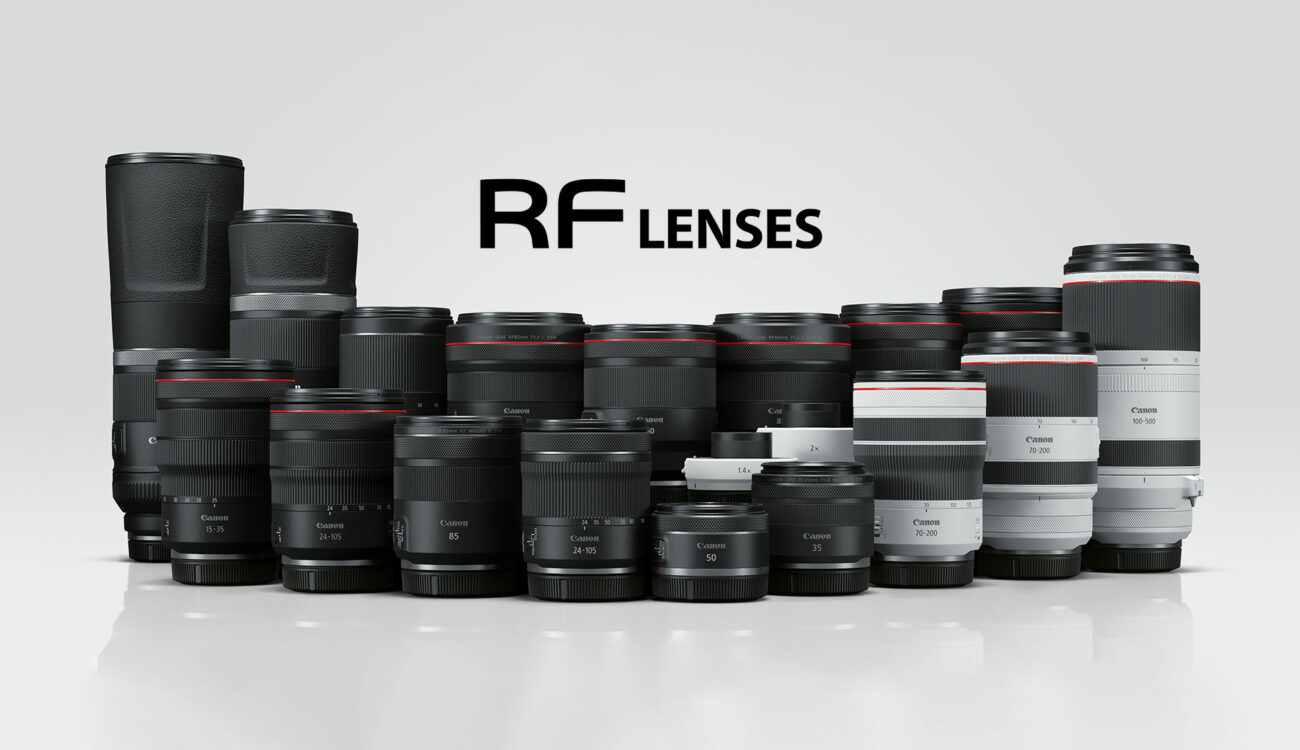
Canon has built out the RF lineup at every level. Affordable RF zooms for travel and everyday shooting. RF-S kit lenses for APS-C
R-series bodies. Compact RF primes for portraits and walk-around use. L-series RF zooms and primes for professionals who need the
highest optical performance. Specialty lenses like the RF 100-500mm L for wildlife or the RF 800mm L for serious telephoto work. The
lineup keeps growing.
Lens Categories to Explore
- RF prime lenses for portraits, low light, and creative work
- RF zoom lenses for travel, events, and weddings
- L-series RF lenses for professional reliability and weather sealing
- RF-S lenses designed specifically for APS-C R-series bodies
- RF telephoto and super-telephoto lenses for wildlife and sports
How to Choose Your First RF Lens
If you bought your R-series camera with a kit lens, your first RF lens upgrade is often a fast prime in the 35mm to 85mm range,
depending on what you shoot. Portrait photographers gravitate toward the RF 85mm; everyday and travel shooters often start with a
35mm or 50mm prime. If you've outgrown a kit zoom, an L-series zoom like the RF 24-70mm f/2.8 L or the RF 70-200mm f/2.8 L is a
meaningful jump in image quality, build, and weather sealing.
Where Camera Canada Comes In
We carry the Canon RF lens lineup along with the full Canon EOS R-series camera family. Free shipping on regular orders over $99 to
most destinations in Canada. Our staff can help you choose the right RF lens for your camera, your shooting style, and your budget,
without pushing you into glass you don't need.
Final Thoughts
Canon's RF mount isn't just a new connector. It's a re-thinking of how a lens system works with a mirrorless camera,
and it gives Canon shooters access to optical designs and ergonomic features that simply weren't possible on EF. If you're
investing in Canon mirrorless, investing in RF lenses is investing in the future of the system.
Ready to Shop Canon RF Lenses?
BROWSE MIRRORLESS LENSES